AI search for restaurants: how assistants decide which places to name
In twelve months, consumers using generative AI for local recommendations went from 6% to 45%. An AI answer names three to five restaurants and stops — there is no page two. This page separates what is actually known from what is being sold, including the tactics Google published official guidance telling you to ignore.
Toggle what your restaurant has published and watch whether it enters the answer — and what the assistant is able to say about it once it does. Being named is not enough on its own; the assistant needs quotable specifics or it will name someone it can describe better. An illustration of the mechanic, not a live query.
What is AI search visibility for restaurants?
AI search visibility, sometimes called AIO or generative engine optimization, is the practice of making sure AI assistants can find, verify and accurately describe your restaurant when someone asks them where to eat. Unlike traditional search it does not produce a ranked list — the assistant names a handful of places in prose and stops. Inclusion appears to depend on having consistent information about your restaurant across several independent sources, specific attributes stated as text, and signals that the information is current. There is no paid placement inside an AI recommendation.
The shift is worth stating plainly because the numbers are unusual. Consumer use of generative AI for local business recommendations rose from 6% to 45% in a single year — the largest twelve-month behavioral change local search has recorded. ChatGPT alone was used by roughly 31% of consumers for business recommendations, and Google's AI Mode has passed a billion monthly users.
What makes this different from ordinary search is the shape of the output. Ten blue links plus ten more meant that being eleventh still produced a trickle. An assistant names three to five restaurants and stops. Being the sixth best-documented restaurant in your city returns nothing — the diner never learns you exist.
The corollary is that gains concentrate. A restaurant that becomes one of the named few captures a disproportionate share of a channel that is still growing fast, which is the entire argument for paying attention now rather than in two years.
The part most operators miss
You do not have to use ChatGPT to be affected by it. 82% of consumers read AI-generated review summaries — the automatic synopses now appearing above reviews on major platforms — and 23% say they would decide on that summary alone. Google replaced its Business Profile Q&A section with Ask Maps, where Gemini answers visitor questions about your restaurant automatically.
Which means a machine is already writing descriptions of your restaurant and showing them to people who have never opened an AI app in their lives. The question is not whether to participate. It is whether what it says is accurate.
What this guide covers
- Where the assistants actually get restaurant information — which is not the same place for each of them.
- What the controlled research found, including the study that named the discipline and what it measured.
- Six tactics Google officially says to ignore — several of which are actively being sold.
- What genuinely works for a restaurant, in priority order.
- How to test whether assistants currently know your restaurant exists.
- How to vet a GEO vendor, using questions Google itself published.
Want to know what AI says about you today?
We run the same prompts a diner would, across ChatGPT, Gemini and Perplexity, and send you what comes back — whether you are named, what is said, and what is wrong. No charge and no obligation.
There is no ad slot inside an AI recommendation. For once, the only way in is to be genuinely well documented — which is unusually fair to independent restaurants.
Where each assistant actually gets its information
These systems do not share a source of truth, which is why a restaurant can be described accurately by one and not exist at all to another. Knowing which reads what tells you where a gap is.
The open web, plus licensed partners
ChatGPT does not read your Google Business Profile. Independent testing indicates it leans on Bing-indexed web results together with its own selection logic, which means your own website carries far more weight here than your Google listing does.
It also now draws on licensed data. OpenAI signed an agreement with Yelp in 2026 that surfaces Yelp reviews, ratings, photos and business details inside ChatGPT — which quietly makes your Yelp listing part of your AI presence whether or not you think about Yelp.
Earlier analysis of ChatGPT's local results found business websites were the most common source type, ahead of mentions on other sites and directory listings. Your site is the asset.
Google's own index and your profile
Google's AI features run on Google's core ranking systems and its own index, which includes your Business Profile, your reviews, and your website. This is the one surface where profile completeness translates fairly directly into AI answer quality.
Ask Maps in particular generates answers to visitor questions from exactly three sources: your profile fields, your reviews, and your site. If those disagree or are thin, it answers badly with your name attached.
Live retrieval with visible citations
Perplexity retrieves and cites sources openly, which makes it the easiest assistant to diagnose — you can see exactly which pages it pulled from. If a competitor is being cited and you are not, the citation list tells you which sources you are missing from.
Smaller share of consumer use than ChatGPT or Gemini, but disproportionately useful as a testing instrument.
Copilot, Claude, and the review summaries
Microsoft Copilot has its own reservation integrations. Claude and other assistants read the open web. And separately from all of them, the AI-generated review summaries on Google and other platforms are synthesizing your reviews into a paragraph that most consumers now read.
The practical implication of the whole picture: you cannot optimize per-platform. What works across all of them is having accurate, specific, corroborated information in public places. That is one job, not five.
Does ChatGPT use my Google Business Profile?
Not directly, in the way Google's own AI features can. Testing indicates ChatGPT relies on web results and its own selection logic rather than Google's local data, so your Google reviews and profile should not be treated as your whole AI strategy. It does read your website, and it now surfaces licensed Yelp content. The practical takeaway for a restaurant that has only ever maintained its Google listing is that it may be well represented in Google's AI answers and effectively invisible in ChatGPT's.
What the research actually found, and what Google actually said
A great deal of confident writing about AI optimization is asserted rather than tested, and some of it is being sold as a service. Two sources have real standing here. Both are worth knowing before you buy anything.
The study that named the discipline
The term generative engine optimization comes from a November 2023 paper by researchers at Princeton, the Allen Institute, Georgia Tech and IIT Delhi. It did something unusual for this field: it tested nine tactics against each other under controlled conditions and measured which ones changed citation rates.
The findings were narrower than the marketing around them. What measurably increased the chance of being cited was including statistics with a clear source, quoting identifiable experts, citing sources explicitly, and writing in fluent, readable language. Each produced a lift in the region of a quarter more visibility.
What did not work: keyword stuffing, padding text, and artificially simplifying content without adding substance. Those moved nothing.
Two caveats the marketing literature tends to skip. The same intervention can lift citations on one engine and barely move them on another, because the systems differ underneath. And the gains, while real, are bounded — no strategy in the study doubled citation rates. This is a discipline of compounding small wins, not a trick.
Google's official position
On 15 May 2026, Google published its first consolidated guide, “Optimizing your website for generative AI features on Google Search,” under a new Generative AI fundamentals section of Search Central. It is the clearest on-record statement about what works inside AI Overviews and AI Mode.
Its central framing is blunt: optimizing for generative AI search is optimizing for the search experience, and is therefore still SEO. Google acknowledges that practitioners use the labels AEO and GEO, then argues the underlying work is unchanged, because its AI features run on the same core ranking systems as ordinary search.
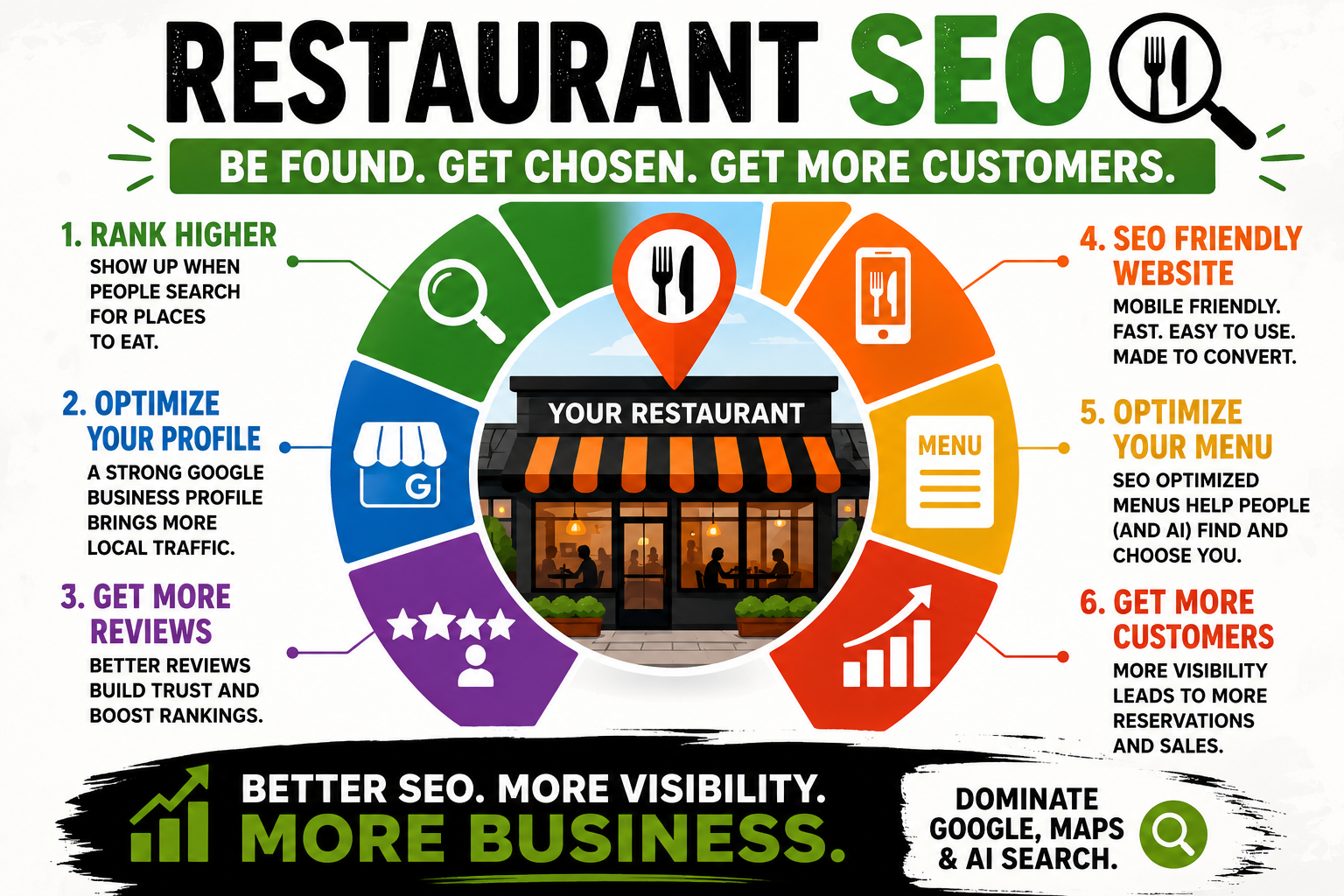
Then it names six tactics you can ignore. Several of them are actively being sold to restaurants right now.
Why we publish this
We sell search services, and this section tells you that several things sold as AI optimization are unnecessary. That is deliberate.
A restaurant owner who has been pitched an “AI visibility package” deserves to know what Google has said on the record before spending money on it — including with us. If our work cannot survive that, it is not worth buying.
Google went further in June 2026 and published vetting questions for hiring an SEO. They are reproduced further down this page. Use them on us.
What Google says you can ignore
llms.txt files and other “special” markup
Google states you do not need to create machine-readable AI text files, special markup or Markdown versions of pages to appear in Google Search including its generative features, because Google Search does not use them. Its crawler may discover the file and treat it like any other text file. Google's updated wording is that keeping one is completely fine for other services that do use them — it simply neither helps nor harms you in Google. Worth knowing because several tools now sell auto-generated llms.txt as a feature.
Chunking your content into fragments
There is no requirement to break content into small pieces for AI systems. Google says its systems understand multi-topic pages and can extract the relevant passage without the author pre-fragmenting the article.
Rewriting content specifically for AI
AI features understand synonyms and general meaning, so rewriting pages to capture every long-tail phrasing variation is not required. For a restaurant this is genuinely freeing: describe your food the way you would to a guest.
Special AI-specific schema
Ordinary structured data remains useful. Inventing AI-flavored markup on top of it is not a thing Google uses. Restaurant, Menu and FAQPage markup done properly is the whole assignment.
Pursuing inauthentic mentions
Manufactured citations and placed mentions are called out directly. This matters for restaurants because “we will get you mentioned across hundreds of sites” is a common pitch, and the low-quality version of it does nothing at best.
Ordinary, well-executed SEO
Crawlable, fast, trustworthy pages. Content a person would find genuinely satisfying. Accurate structured data. Google's own summary of the guidance is that matching the fundamentals is what makes you eligible — and being genuinely worth citing is what wins the slot.
Do I need an llms.txt file for my restaurant website?
Not for Google. Google's guidance states explicitly that Google Search, including its generative AI features, does not use llms.txt files, and that having one neither helps nor harms your visibility there. Google also notes it is perfectly fine to maintain one for other services or systems that do read them, and some agent-oriented tools have adopted the convention. So: harmless, cheap, possibly useful elsewhere, and definitely not the thing standing between your restaurant and being recommended. If a vendor is charging you for one as an AI visibility service, that is the wrong thing to be paying for.
What genuinely moves AI visibility for a restaurant
Ordered by return for a restaurant specifically. Note how much of it overlaps with things you would do anyway — that overlap is the point, and it means the effort is not speculative.
A menu published as readable text
The single largest determinant of what an assistant can say about you. A model building a recommendation needs quotable specifics — dishes, prices, dietary options. A restaurant with a readable menu supplies all of it. A restaurant with a photographed menu supplies a name and an address, which is not enough to recommend confidently over an alternative that can be described.
This is why the menu guide is the companion to this page rather than a separate topic.
Attributes stated in plain text
Real queries carry conditions: quiet, cheap, open late, good for groups, gluten free, has a patio, takes reservations, near a landmark. Matching requires each attribute to exist as text somewhere readable — on your site, in your profile fields, in your reviews.
A private room that seats eighteen and is never mentioned online does not exist to any of these systems. Write the sentence.
Corroboration across independent sources
A restaurant described consistently by its own site, its Google profile, its Yelp listing, a couple of directories and a local guide presents a coherent picture. One described differently in each place presents ambiguity, and ambiguity appears to suppress inclusion.
This is the mechanism behind the boring advice about consistent names, addresses and phone numbers. It was always about machine confidence; now the stakes are visible.
Recent reviews, and replies to them
Reviews are both a freshness signal and raw material. AI review summaries are generated directly from your review text, which means what your guests write becomes the description a machine gives of your restaurant. Recent reviews weigh more heavily than old ones.
Covered fully in the reviews guide.
Freshness on the pages that matter
Independent measurement puts a meaningful freshness premium on cited sources — AI systems lean toward material that has been updated recently. A menu page revised this season, current hours, a visible last-updated date. A site that has not changed since 2023 competes badly regardless of quality.
For a restaurant this is easy, because your menu genuinely changes. Just make sure the website changes with it.
Being mentioned by sources that get read
City guides, neighborhood roundups, local food writers, event coverage, relevant directories. Genuine third-party coverage is one of the few things the controlled research and Google's guidance agree on — and it is explicitly the authentic version, not a bulk citation package.
Being placed in a real vertical directory such as a local food directory does this job honestly.
Crawler access left open
Blocking GPTBot, ClaudeBot, PerplexityBot or Google-Extended removes any possibility of being named. The publisher logic for blocking them does not transfer: a news site loses revenue when its article is summarized; a restaurant sells tables, so being quoted accurately with your name attached sends people to your door.
Some site builders block these by default without telling you. Check your robots.txt directly — details below.
A site that is fast and structurally clear
Google's guidance notes that browser-based AI agents now analyze pages including their structure and rendering. A slow, script-heavy page that hides its content behind JavaScript fails both the agent and the human.
If your site is the obstacle, Search Converts builds fast restaurant websites designed to be read by both.
How do I get my restaurant recommended by ChatGPT?
There is no submission process and nothing to buy — inclusion is earned through documentation. In practice: publish your menu as readable text on your own site, state your attributes plainly (atmosphere, price range, dietary options, group capacity, hours), keep your details identical across your website, Google, Yelp and any directories that list you, collect recent reviews, make sure your site is crawlable by AI bots, and get mentioned by genuine local sources. Because ChatGPT reads the open web rather than your Google profile, your own website carries more weight here than your Google listing. Expect this to improve gradually as pages are recrawled rather than switching on at a date.
Check that you are not blocking the assistants
This takes two minutes and it is total when it goes wrong. Type your domain into a browser followed by /robots.txt — for example yourrestaurant.com/robots.txt — and read what comes back.
If you see any of the AI crawler names alongside Disallow: /, you are invisible to that assistant no matter what else you do. The names to look for are GPTBot and OAI-SearchBot (OpenAI), ClaudeBot, PerplexityBot, Google-Extended, and Applebot-Extended.
Some website builders and security plugins block these by default, on the reasonable-sounding logic that AI companies should not train on your content for free. For a publisher that argument has weight. For a restaurant it is self-harm: you are not selling the text, you are selling the tables the text sends people to.
While you are in there, check for a stray noindex tag left over from when the site was built. It happens more often than you would think and it removes you from ordinary search too.
Should restaurants block AI crawlers?
No. Blocking them removes any possibility of being named in an AI recommendation, which is now the third most popular source of local business recommendations. The reasoning that leads news publishers to block these crawlers does not apply to a business that sells food rather than articles — being quoted accurately with your name attached is the entire outcome you want. Check your robots.txt directly rather than assuming, because some platforms block them by default.
A restaurant robots.txt, roughly
You do not need to list every crawler individually. A simple permissive file covers it:
The only reason to name crawlers explicitly is if you previously blocked some and want to be certain the blocks are gone. If your file currently contains Disallow lines you do not recognize, that is worth having someone look at.
How to test whether AI knows you exist
Do this yourself, this week. It takes fifteen minutes and it is more informative than any dashboard.
- Open ChatGPT, Gemini and Perplexity. Ask each the way a diner would: “best [your cuisine] in [your neighborhood]”. Note who gets named.
- Ask a constraint question you should win: “somewhere with a patio that takes large groups in [your area]”.
- Ask directly: “tell me about [your restaurant name]”. Check every fact it returns. Wrong hours and dead dishes are common.
- On Perplexity, read the citations. They tell you which sources the answer was built from — and which ones you are missing from.
- Repeat quarterly. Answers vary between runs, so treat one result as a signal rather than a verdict.
When the assistant books the table itself
For about a year, AI agents could find your restaurant and then politely give up. On 10 August 2026 that gap closed, and it changes what “being recommended” is worth.
Through early 2026 the standard demonstration ended the same way: the model found the restaurant, showed the available times, and handed control back to the human. Reservations existed on the screen but not in the conversation.
Then OpenAI turned on restaurant reservations inside ChatGPT through OpenTable, Resy and Yelp. A diner describes what they want in ordinary language — neighborhood, time, party size, cuisine, budget, dietary needs, atmosphere — sees real available times in the response, and books without leaving the chat. Reservations run globally through OpenTable and across the US and Canada through Resy and Yelp, with Yelp also covering waitlists.
Google arrived at the same place from its own direction earlier in the year, adding AI-driven booking that finds a restaurant, checks availability and confirms the reservation as one flow. Microsoft Copilot has its own integration.
Why this raises the stakes on documentation
Previously a diner who got a recommendation still had to visit your site or your Maps listing to act, which gave you a second chance to convince them. Now the decision can complete inside the conversation.
That does two things. It makes being named in the recommendation itself far more valuable, because there is no second look. And it makes every attribute in the request — quiet, under $40, vegetarian, 7pm, party of four — a filter applied against documented facts. Undocumented facts do not participate.
Reservations were chosen as the first agentic use case deliberately: high volume, high intent, low stakes, because the worst outcome is an empty table rather than a disputed charge. Ordering is the obvious next step. When an assistant can place a takeout order the way it now holds a table, the restaurants with structured, machine-readable menus are the ones it will be able to order from.
What to do about it now
- Be bookable somewhere an assistant can reach. If you take reservations only by phone, an assistant can recommend you and still not close the loop.
- Waitlists count. Yelp's integration covers joining a waitlist, which matters for walk-in rooms that never took bookings.
- Document the constraints people actually ask about. Noise level, price range, group capacity, dietary handling, patio, parking, late hours.
- Keep the menu machine-readable. It is already the difference in recommendations and it will be the difference in ordering.
- Nothing here is purchasable. Still no ad slot inside an AI recommendation. Documentation is the only route in.
Ordering under your own roof
If the next step is agents placing orders, the restaurants that own their ordering keep the margin instead of paying commission on it. Search Converts builds custom restaurant ordering applications alongside websites — static, WordPress, Shopify or fully bespoke.
How to vet anyone selling you AI visibility
In June 2026 Google updated its guidance on hiring an SEO with questions aimed specifically at AI optimization pitches. They are good questions and they cost nothing to ask. Ask them of us too.
Does their advice cite official documentation?
A credible provider can point to a page on Google's own developer documentation behind each recommendation. If a pitch rests entirely on proprietary “AI ranking factors” that nobody outside the company can verify, treat it as opinion rather than fact.
Is it aligned with the May 2026 guidance?
Cross-check what is being sold against the tactics Google named as unnecessary. If someone is charging for llms.txt files, content chunking or special AI schema as their AI visibility service, they are selling work Google has said you do not need.
Do their tools align with that guidance?
No external tool has access to Google's internal ranking data. Dashboards showing an “AI visibility score” are estimates built on sampling. Useful directionally, not authoritative, and worth understanding as such before you make decisions from them.
Three more worth adding
- What exactly will you deliver? Deliverables are checkable. “AI visibility” as an outcome is not.
- Who owns the assets? Your Google profile, your website, your domain, your content. All of it should be in accounts you control.
- What happens if we stop? A menu converted to structured pages stays converted. A rented citation package disappears.
Claims that should end the conversation
- Guaranteed inclusion in ChatGPT or AI Overviews
- A specific ranking position by a specific date
- A “partnership” or paid placement with an AI company for recommendations
- Bulk citation packages promising hundreds of mentions
- Anything requiring you to hand over ownership rather than access
Nobody sells placement inside an AI recommendation, because nobody has it to sell. Anyone claiming otherwise has told you something useful about themselves.
Where restaurants lose AI visibility
Treating Google as the whole strategy
A restaurant with an immaculate Google profile and a thin website can be well represented in Google's AI answers and effectively unknown to ChatGPT, which reads the open web instead.
Details that disagree across platforms
Different hours on Yelp, an old phone on a directory, a suite number that appears in one place and not another. Ambiguity reads as uncertainty, and uncertain businesses get left out of short lists.
Nothing quotable on the website
A full-screen photograph, the word “Welcome,” and a phone number. There is nothing here for an assistant to say about you, so it names a restaurant it can describe.
Blocking crawlers by accident
A default setting in a site builder or a security plugin, switched on by someone who never mentioned it. Silent, total, and takes two minutes to check.
Buying tactics Google named as unnecessary
Money spent on llms.txt generation, content chunking or special AI schema is money not spent on the menu conversion that would actually change what an assistant can say.
Never checking what is being said
Assistants confidently describe restaurants using stale data — dishes discontinued years ago, hours from a previous owner. Nobody tells you. You have to look.
AI search questions from restaurant owners
What is AI search visibility for restaurants?
AI search visibility, sometimes called AIO or generative engine optimization, is the practice of making sure AI assistants can find, verify and accurately describe your restaurant when someone asks them where to eat. Unlike traditional search it does not produce a ranked list — the assistant names three to five places in prose and stops. Inclusion appears to depend on consistent information about your restaurant across several independent sources, specific attributes stated as text, and signals that the information is current. There is no paid placement inside an AI recommendation.
How does ChatGPT decide which restaurants to recommend?
No AI company publishes its selection logic, so this is observation rather than confirmed mechanics. What consistently appears to matter is corroboration — consistent, verifiable information across several independent sources — along with specific quotable attributes such as dishes, prices, atmosphere and dietary options, and signals that the information is current. What does not appear to matter is paid advertising, since there is no ad slot inside an AI recommendation, along with social follower counts and third-party authority scores. Restaurants that are invisible usually have thin documentation rather than a penalty.
How do I get my restaurant recommended by ChatGPT?
There is no submission process and nothing to buy. In practice: publish your menu as readable text on your own site, state your attributes plainly including atmosphere, price range, dietary options and group capacity, keep your details identical across your website, Google, Yelp and any directories, collect recent reviews, ensure your site is crawlable by AI bots, and get mentioned by genuine local sources. Because ChatGPT reads the open web rather than your Google profile, your own website carries more weight here than your Google listing does.
Does ChatGPT use my Google Business Profile?
Not directly, in the way Google's own AI features can. Independent testing indicates ChatGPT relies on web results and its own selection logic rather than Google's local data, so your Google reviews and profile should not be treated as your whole AI strategy. It does read your website, and it now surfaces licensed Yelp content following an agreement between the two companies. A restaurant that has only ever maintained its Google listing may be well represented in Google's AI answers and effectively invisible in ChatGPT's.
Do I need an llms.txt file for my restaurant website?
Not for Google. Google's May 2026 guidance states explicitly that Google Search, including its generative AI features, does not use llms.txt files, and that having one neither helps nor harms visibility there. Google also notes it is completely fine to maintain one for other services or systems that do read them, and some agent-oriented tools have adopted the convention. So it is harmless and possibly useful elsewhere, but it is not what stands between your restaurant and being recommended. If a vendor is charging you for one as an AI visibility service, that is the wrong thing to be paying for.
Should restaurants block AI crawlers?
No. Blocking GPTBot, OAI-SearchBot, ClaudeBot, PerplexityBot, Google-Extended or Applebot-Extended removes any possibility of being named in an AI recommendation, which is now among the most-used sources of local business recommendations. The reasoning that leads news publishers to block these crawlers does not transfer to a business that sells food rather than articles — being quoted accurately with your name attached is exactly the outcome you want. Check your robots.txt directly rather than assuming, because some website builders block them by default.
Is GEO different from SEO for restaurants?
Less than the marketing suggests. Google's official position, published in May 2026, is that optimizing for generative AI search is optimizing for the search experience and is therefore still SEO, because its AI features run on the same core ranking systems. The controlled research that named generative engine optimization found that what lifts citation rates is sourced statistics, quotable expertise, explicit citations and clear writing — none of which is exotic. For a restaurant the practical answer is that there is one body of work: accurate listings, a readable menu, real reviews, a fast site, and genuine third-party mentions.
Can I pay to appear in AI recommendations?
No. There is currently no ad inventory inside a generative AI recommendation — no slot, no bid, no sponsored position within the answer itself. This is unusual and it is unusually favorable to independent restaurants, because a twelve-table neighborhood room can be named ahead of a chain if its information is better structured. Anyone offering paid placement or a guaranteed partnership for inclusion is describing something that does not exist.
How long does it take to appear in AI answers?
It is not schedulable, which is a genuinely unsatisfying answer. Changes to your website need to be recrawled, corroborating sources need to pick up the same facts, and each assistant refreshes on its own timetable. Practically, restaurants tend to see accuracy improve first — the assistant stops citing an old menu — before inclusion improves. Treat it as a compounding effect over months rather than a switch, and be suspicious of anyone who puts a date on it.
How do I check what AI says about my restaurant?
Ask it yourself, the way a diner would. Open ChatGPT, Gemini and Perplexity and try three prompts: a category query such as best Thai in your neighborhood, a constraint query such as somewhere with a patio for a large group, and a direct one — tell me about your restaurant by name. Check every fact returned, since wrong hours and discontinued dishes are common. On Perplexity, read the citations to see which sources the answer was built from and which ones you are absent from. Repeat quarterly, and treat a single run as a signal rather than a verdict, because answers vary.
Can ChatGPT book a table at my restaurant?
As of 10 August 2026, yes, if you are on a supported reservation platform. OpenAI turned on in-chat reservations through OpenTable, Resy and Yelp, letting a diner describe what they want, see real available times, and book without leaving the conversation. Reservations run globally through OpenTable and across the US and Canada through Resy and Yelp, with Yelp also covering waitlists. Google and Microsoft Copilot have comparable paths. If you only take reservations by phone, an assistant can recommend you but cannot complete the booking.
Do I need to hire someone for AI search optimization?
Not necessarily, and it is worth being skeptical of packages sold specifically as AI optimization. Google published vetting questions in June 2026: does the provider's advice cite official documentation, is it aligned with Google's published generative AI guidance, and do their tools align with it. Cross-check anything you are being sold against the tactics Google named as unnecessary. The work that genuinely helps — converting a menu, cleaning up inconsistent listings, fixing a slow site, building a review habit — is ordinary work you can either do yourself or hire for on clear, checkable deliverables.
Find out what the assistants say about you
The fifteen-minute test earlier on this page is genuinely worth doing yourself, and we would rather you did it than took our word for anything. If you would like it done properly instead, we will run the prompts a diner would actually use across ChatGPT, Gemini and Perplexity, and send you the raw answers: whether you are named, what is said about you, what is factually wrong, and which sources the answers were built from.
No charge, no obligation, and if the answer is that you are already well represented, that is what we will tell you.
Related reading
- The complete restaurant SEO guide — the overview this sits inside, covering all nine surfaces where diners search.
- Restaurant menu SEO — the single largest determinant of what an assistant can say about your food.
- Google Maps visibility — the profile data that feeds Google's own AI answers and Ask Maps.
- Reviews and ratings — the raw material AI review summaries are generated from.
- Statistics and benchmarks — sourced data behind the figures on this page.
- Restaurant advertising — the paid channels, which remain the only ones you can actually buy.