Every search is a road to your door. Most restaurants are only on one of them.
A diner types “good tacos near me.” Someone else asks ChatGPT for “somewhere quiet for a first date, under $40.” A third opens Apple Maps and searches nothing at all — they just look at what is nearby and open. Those are three completely different roads, and your restaurant either sits on them or it does not. This page explains how each one works, in plain English, with nothing sold to you before you understand it.
Drag the slider. Each surface you appear on opens a new set of roads — and each road carries its own searches. This is the whole idea behind restaurant SEO: not one ranking, but coverage. A restaurant on two surfaces is invisible to most of the room. Nothing here is a projection of your actual traffic; it is an illustration of how coverage compounds.
ChatGPT now books restaurant tables inside the conversation. OpenAI turned on reservations through OpenTable, Resy and Yelp two days ago, which means an assistant can go from “where should we eat” to a confirmed table without the diner ever visiting a website or a map. What that changes for your restaurant →
If you only read one box
- Being on Google is not a strategy anymore. Consumers now check an average of six sources before choosing a place to eat, and AI assistants went from 6% to 45% adoption for local recommendations in a single year.
- Your menu is your most valuable SEO asset, and most restaurants have hidden it. A menu locked in a PDF or a photo cannot be read by Google or by any AI model. Every dish you sell is a search you are not showing up for.
- Reviews expire faster than they used to. 74% of diners only weigh reviews from the last three months. A brilliant 4.8 built on reviews from 2023 reads as a restaurant that used to be good.
- AI answers name three to five places, then stop. There is no page two. Being the sixth-best-documented restaurant in your city returns nothing at all.
- None of this is exotic. Accurate listings, readable menus, fresh reviews, a fast site. The work is unglamorous and it is the same work that pays on every surface at once.
What restaurant SEO actually is
Strip away the acronyms and it is a simple idea: making sure that when someone nearby is deciding where to eat, your restaurant is one of the options they are shown — and that what they see makes them want to come.
What is restaurant SEO?
Restaurant SEO is the practice of making a restaurant findable and convincing on the surfaces where people decide where to eat: Google Search, Google Maps, Apple Maps, review platforms, and now AI assistants like ChatGPT and Gemini. In practice it means claiming and completing your listings, publishing your menu as readable text rather than a picture, earning steady recent reviews, keeping every mention of your name, address and hours identical everywhere, and running a website that loads fast on a phone. It is not a trick played on an algorithm. It is putting accurate, specific, current information in the places machines and diners both read.
The phrase itself is marketing jargon, and most restaurant owners never search for it. You are far more likely to have typed something like “why isn't my restaurant showing up on Google” or “how do I get more Google reviews” at eleven at night after a bad Tuesday. Those are the real questions. SEO is just the label the industry put on the answers.
Here is the honest framing. A restaurant has two ways to fill a table. The first is the one you already do well: cook food people want, treat them properly, and let them tell their friends. That has worked since restaurants existed and it still works. The second is being present at the exact moment a stranger — someone who has never heard of you, who is standing four blocks away, who is hungry right now — asks a machine where to eat. That moment happens hundreds of times a day in your neighborhood. You are either in the answer or you are not.
What makes restaurants different from most local businesses is the sheer specificity of the questions people ask. Nobody searches for “a plumber who is good with copper and has a quiet waiting room.” But people absolutely search for birria tacos open late near Five Points, gluten free pasta downtown, restaurant with a patio that takes big groups, and where can I get good pho at 2pm on a Sunday. Every one of those is a real search with real intent and a real credit card behind it. And every one of them requires that a specific fact about your restaurant exists, in text, somewhere a machine can read it.
That is the whole game. Not keywords. Facts, published in a readable form.

The five things SEO is not
- It is not paying Google to rank higher. That is advertising, which is a separate and legitimate thing. Organic placement in the map results is not for sale.
- It is not keyword stuffing your business name. Renaming yourself “Joe's Best Italian Restaurant Denver Pasta” is against Google's guidelines and profiles are being suspended for it.
- It is not a one-time setup. Hours change, menus change, reviews age out. A listing that was perfect in January is stale by June.
- It is not something that guarantees a position. Anyone promising you the top spot by a date is either guessing or lying. Nobody controls the ranking.
- It is not separate from your operation. The restaurant that answers the phone, updates its hours on a holiday, and replies to a bad review is doing SEO whether it calls it that or not.
The best restaurant SEO advice is often just operational advice with a search consequence attached.
Why this moves covers, not just rankings
Rankings are a vanity metric until they turn into someone sitting down. Here is the actual chain of events, and where restaurants tend to break it.
The decision happens in about ninety seconds
Watch someone choose a restaurant on their phone and you will see the same sequence almost every time. They search. They glance at three or four results. They tap one. They look at the star rating, then the photos, then — if they are still interested — the menu. Then they either call, book, or go back and tap the next one.
Each of those steps is a filter, and each one has a threshold that a measurable share of people will not go below. 68% of consumers now require at least a 4.0 star rating, and 31% will not consider anything under 4.5. Nearly half will not use a business with fewer than twenty reviews. If your photos are four years old and show an empty dining room, you lose people there. If your menu opens as a slow PDF that they have to pinch and zoom on a phone, you lose people there too — and you lose them silently, because nobody emails you to say they gave up on your menu.
The point of restaurant SEO is not to win a competition. It is to remove the reasons people quietly eliminate you before they ever taste anything.
The gap that is hard to look away from
Two numbers sit uncomfortably next to each other. Only about 40% of local businesses have a dedicated website. Meanwhile 54% of consumers now visit a business website after reading positive reviews, up from 32% in 2019. Demand for the website went up by twenty-two points while supply barely moved.
For a restaurant that already has a decent site, that gap is an opportunity rather than a problem. It means that in most neighborhoods, being genuinely well-documented online is not a competitive fight — it is just something most of your competitors have not bothered to do.
Does SEO actually work for a small independent restaurant?
Usually better than it does for a chain, for one structural reason: restaurant search is overwhelmingly local, and proximity is a ranking factor you already own by having an address. A twelve-table neighborhood room can outrank a national brand for “lunch near me” within its own few blocks, because the chain's size does not help it be closer. What independents lose on is documentation — chains have staff whose whole job is keeping listings accurate. Close that gap and the playing field is unusually level.
Not sure where you stand?
The 60-second checkup further down this page asks six questions and tells you which thresholds you clear. No email required, nothing sent anywhere. Or call us and we will look at it with you.
The nine surfaces a hungry stranger might use
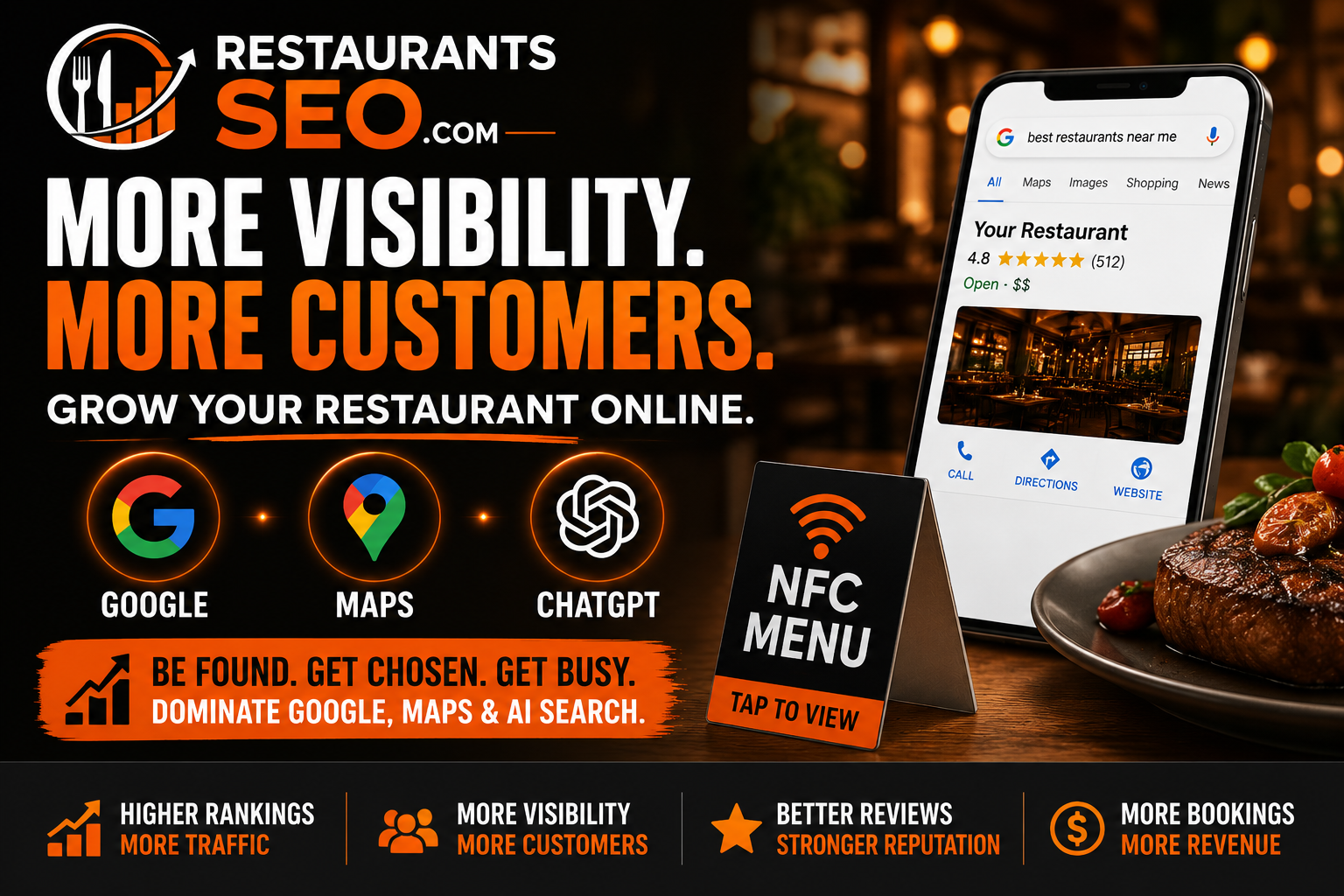
This is the list behind the web diagram at the top of the page. Most restaurants are meaningfully present on two or three. Each one you add is a new road to your door — and several of them cost nothing but an afternoon.
Google Search
Still the largest single channel by a distance, and still where roughly half of all local searches begin. This is the classic blue-link results page plus the local pack of three businesses with a map. Your website, your listing and any directory that mentions you are all competing here.
Google Maps
A distinct product with distinct behavior. People on Maps are usually already out, already close, and already ready to eat. Maps traffic converts harder than almost anything else. It is driven by your Google Business Profile, not your website, which is why the profile deserves more attention than most owners give it.
Google AI Mode and AI Overviews
Google's conversational layer, which now handles enormous volume — AI Mode alone has passed a billion monthly users. Ask it a complicated question like “where can I take my in-laws that has vegetarian options and is not loud” and it answers in prose, naming a handful of places. It pulls from your profile, your reviews, and your website's actual text.
ChatGPT
Used by roughly 31% of consumers for business recommendations in the past year, and now able to book a table without leaving the chat. It reads the open web and licensed sources rather than Google's index, which means your presence on Google alone does not guarantee it knows you exist.
Apple Maps
The one almost nobody claims, and the reason it belongs on this list. Apple Maps usage for finding local businesses nearly doubled in a year to 27%. It is the default map on every iPhone, which means it is the default for travelers and for anyone who simply taps the icon already on their home screen. Apple Business Connect is free and takes about twenty minutes.
Yelp and Tripadvisor
Less dominant than a decade ago but far from irrelevant, particularly for visitors and for higher-consideration meals. Yelp's data is also now licensed into ChatGPT, which quietly makes your Yelp listing part of your AI presence whether you think about Yelp or not.
Instagram and TikTok search
A meaningful share of younger diners search inside social apps rather than a search engine, looking for what a place actually looks and feels like. Geotagging every post and keeping your location page populated is the low-effort version of showing up here.
Local guides and directories
City restaurant guides, neighborhood roundups, food blogs, and vertical directories. These matter for two reasons: people genuinely read them, and AI models lean heavily on them for corroboration. A restaurant described consistently across several independent sources reads as real. One that appears only on its own website reads as a claim.
Delivery marketplaces
DoorDash, Uber Eats and Grubhub function as search engines for people who have already decided to stay home. Worth being on for reach, worth watching closely for margin: commission runs 15–30% with effective costs often reaching 30–40% once promotions and refunds are counted, against a typical 3–5% net margin.
Which of these should a restaurant do first?
Google Business Profile, then the menu. The profile is free, controls both Google Search and Google Maps, and is the single most-referenced source of facts about your restaurant across every other surface including AI assistants. Converting your menu from a PDF or image into readable text is second because it is the change that unlocks the highest-intent searches in the category — the ones naming a specific dish. Everything else is worth doing, but those two carry most of the weight.
Want the list checked rather than read?
We will audit all nine surfaces for your restaurant, tell you which ones you are missing, and hand you the findings whether or not you hire anyone. There is no obligation attached to knowing where you stand. Call 1-800-481-8638 or start with Eye To Ad Media.
How diners actually type, and what each pattern wants
Restaurant searches fall into a handful of recognizable shapes. Knowing which shape you are trying to win tells you what has to exist on your site — and stops you writing pages nobody asked for.
“Near me” and proximity searches
restaurants near me · food near me · places to eat near me · open now near me
The highest volume and the highest urgency. The person is out, hungry, and deciding in the next few minutes. Almost nothing about your website affects this — it is decided by proximity, your Google Business Profile completeness, your rating, and whether your hours say you are open right now. The single most common failure here is wrong holiday hours.
Cuisine plus location
mexican restaurant denver · italian food in cherry creek · best sushi near capitol hill
The workhorse pattern. Slightly less urgent, more comparison shopping. Won by a combination of listing category accuracy, review volume, and having real text on your site that establishes what you are. If your website never plainly says the words “Mexican restaurant,” you have made this harder than it needs to be.
Dish-level searches
birria tacos denver · best pad see ew near me · where to get oxtail · gluten free pizza crust
The most valuable and the most neglected. Somebody searching for a specific dish has already decided what they want to eat; they are only choosing where. These searches are won almost entirely by having a readable text menu. If your dishes exist only inside a PDF or a photograph, you cannot appear for any of them, no matter how good the dish is.
Occasion and constraint searches
restaurant for a birthday dinner · good for large groups · quiet enough to talk · kid friendly patio
Growing quickly because AI assistants handle them well. These are matched against attributes, and attributes only count if they exist as text. “We have a private room that seats eighteen” written on your site is a fact that can be matched. The same private room, existing only in reality, cannot.
Dietary and allergen searches
gluten free restaurants near me · vegan options · halal food · nut free bakery
High intent, high loyalty, and frequently ignored. A diner with celiac disease who finds a restaurant that clearly documents its handling becomes a repeat customer and brings a table with them. This requires honest, specific language on the site, not a vague claim.
Branded and navigational
[your restaurant name] menu · [your name] hours · [your name] reservations
People who already know you and want a fact. Easy to win and easy to fumble. The most common mistake is that the top result for your own name is a third-party delivery page rather than your own site, which costs you both the margin and the relationship.
Every one of these patterns is answered by a fact. Restaurant SEO is mostly the work of making sure the facts exist, in text, where a machine can find them.
Should a restaurant do keyword research?
Lightly, and mostly to confirm what you already know. Your menu is your keyword list — every dish, every cuisine descriptor, every dietary accommodation is a phrase someone searches. The useful exercise is not finding exotic keywords, it is checking that each thing you actually sell appears somewhere in readable text on your website. Most restaurants discover they are missing dozens of their own dishes.
Google Business Profile: the thing to fix first
Your profile is no longer just a listing. It has quietly become the canonical record that Google Search, Google Maps, Google's AI answers and several third-party systems all read from. Treat it as your restaurant's primary public database entry.

How do I get my restaurant on Google?
Create or claim a free Google Business Profile at google.com/business using the restaurant's own email address, not a former marketing agency's. Google verifies you by phone call, text, WhatsApp or video — postcards are largely retired. Then complete every field: category, hours, holiday hours, phone, website, service options, attributes, and a menu link. Add real photos. The whole process takes an afternoon and verification usually clears within a few days.
What changed in 2026, and why it matters more than it sounds
Three shifts happened quietly over the past year, and together they change how the profile should be managed.
The Q&A section is gone. Google discontinued the Business Profile Q&A API on 3 November 2025 and began removing the public section shortly after. In its place is Ask Maps, where Google's Gemini models generate answers to visitor questions automatically. The practical consequence is significant: you can no longer pre-write the answer to “do you have parking?” The AI will answer it regardless, using your profile, your reviews, and your website. If those sources are thin or contradictory, it will answer badly on your behalf. An empty FAQ page is not neutral — it is missing evidence.
Freshness windows tightened. Photos are now sorted by most recent and the profile freshness window has narrowed considerably. A profile that has not been touched in six months reads as a business that may not be operating.
Enforcement got sharper. Google's March 2026 core update suspended a wave of profiles for keyword stuffing in the business name field. If your listing says anything other than the name on your sign, fix it before it becomes a suspension.
The profile checklist worth actually doing
- Primary category set precisely. “Mexican Restaurant” not “Restaurant.” Add secondary categories for anything genuinely true — bar, breakfast, caterer.
- Name matches your signage exactly. No cities, no keywords, no taglines.
- Hours correct, including holidays. Set special hours in advance for every holiday you close or shorten. Wrong hours generate one-star reviews from people who drove over.
- Every attribute filled. Outdoor seating, wheelchair accessible entrance, takes reservations, good for groups, serves vegetarian. These are literally the fields AI systems match constraint queries against.
- Menu link points at a real HTML page on your own domain, not a PDF and not a delivery marketplace.
- Photos refreshed regularly. Food, room, exterior at night, staff. Ten good current photos beat fifty from 2021.
- Posts published consistently. Specials, events, seasonal menus. Activity is a signal that the business is alive.
- Ownership held by you. Not an agency, not a former manager, not a web designer who has stopped returning calls. If you cannot log in, start the reclaim process today.
Why isn't my restaurant showing up on Google Maps?
In order of how often it turns out to be the cause: the profile was never claimed or verified; the profile is suspended, often for a keyword-stuffed name or an address mismatch; there are duplicate listings competing with each other; the address or map pin is wrong; the primary category is too generic; or you are simply outside the search radius of where the person was standing, which no amount of optimization changes. The first four are all fixable, and the first is far more common than owners expect.
Reviews: the standards moved, and they moved fast
Everyone knows reviews matter. What most operators have not caught up with is how much harder the thresholds became in a single year, and how quickly reviews now go stale.
| Threshold | What it means for you | Change |
|---|---|---|
| 4.0 stars | 68% of consumers require at least a four-star rating before they will consider a business at all. | up from 55% |
| 4.5 stars | 31% will only use a business rated 4.5 or higher. This is now the practical target rather than a stretch goal. | up from 17% |
| 20 reviews | 47% will not use a business with fewer than twenty reviews. Only 9% will use one with five or fewer. | volume floor |
| 90 days | 74% only weigh reviews written in the last three months. Older reviews stop counting in the diner's head. | recency window |
| 14 days | 32% specifically look for reviews from the last two weeks. | up from 20% |
| All replies | 80% are more likely to use a business that answers every review. 42% are unlikely to use one that never replies. | response rate |
| Same day | 19% now expect a same-day response to their review; 81% expect one within a week. | up from 6% |
| 97% | of consumers read reviews for local businesses, and 41% now “always” read them before choosing. | up from 29% |
The recency problem nobody plans for
Here is the trap that catches good restaurants. You open, you are excellent, you collect two hundred reviews in your first eighteen months, you settle at 4.7. Then you get busy running the restaurant and stop asking. Three years later the rating still says 4.7 — but the newest review is eight months old.
To a diner scanning quickly, that reads as a place that used to be good. To Google and to AI models, stale reviews are a weak freshness signal. The rating you worked for stops working for you.
The arithmetic is simple and slightly relentless: to keep your newest review inside the ninety-day window all year, you need roughly four new reviews a month, every month, forever. Not a campaign. A habit.
Asking is the whole constraint
The encouraging finding in the data is that diners are willing. 83% of people who were asked for a review wrote one, and the share who say they will “always” write a review when asked rose from 16% to 28% in a year. The bottleneck is not consumer reluctance. It is that most restaurants never ask, or ask once and stop.
What works: asking in person at the moment of genuine satisfaction, from whoever the guest actually connected with. A card with a short link on it. A follow-up text if you take reservations. What does not work: incentives, which violate platform policies and now carry federal enforcement risk under the FTC's Consumer Review Rule.
How should a restaurant respond to a bad review?
Quickly, specifically, and for the audience rather than the reviewer. The person who wrote it has largely made up their mind; the fifty people who read your reply have not. Acknowledge the specific thing that went wrong, say what you are doing about it, and offer to continue the conversation off the platform. Avoid templates — 50% of consumers are put off by generic replies, and a canned response to a detailed complaint reads as indifference. Never argue about facts in public, even when you are right.
A review habit that survives a busy Friday
The restaurants that keep review velocity steady have made it a shift routine rather than a marketing project. One version that holds up:
- A short link and QR on the check presenter, refreshed so it never looks worn
- One manager owns asking, and asks two tables a shift — not every table
- Reviews checked at open and at close, replies written same day
- A monthly count written on the same board as your covers, so it is visible when it slips
Reviews are a system, not a burst
If you would rather not build the habit from scratch, review generation and response is one of the things we run for restaurant clients — along with the rest of it. Restaurant advertising and marketing services covers the paid side; the organic work sits with us.
The website: fast, factual, and yours
Your site is no longer where most people find you. It is where they decide, and where every other system goes to check its facts. Those are two very different jobs from the one restaurant websites were originally built for.
Speed is not a technicality, it is a bounce rate
Roughly 73% of local business searches start on a phone, frequently on a weak connection, frequently while the person is walking. A restaurant homepage that opens with a five-megabyte hero video and three tracking scripts takes six seconds to become useful. A meaningful share of people are gone before it finishes.
The target for a restaurant site is genuinely modest: usable in about a second on a mid-range phone. That is entirely achievable with compressed images, no unnecessary scripts, and a design that puts the four things people came for — menu, hours, location, phone — within immediate reach.
The four-tap test
Open your own site on your phone, right now, as if you were a stranger. Count the taps to reach each of these:
- Today's hours, without doing arithmetic on a weekly table
- The full menu with prices, as text
- A phone number that dials when tapped
- Directions that open in a map app
If any of those takes more than two taps, that is the highest-value fix on your website, ahead of anything on this page. Most restaurant sites fail this test on the menu.
Structured data, briefly
Structured data is a block of code that states facts about your restaurant in a format machines read without interpretation: cuisine type, price range, hours, address, accepted payments, menu items. For restaurants the relevant types are Restaurant, Menu and FAQPage. It is the difference between a machine inferring what you are and being told.
One caution worth stating plainly, because plenty of agencies do the opposite: do not add review or rating markup to your own website claiming your own star rating. Self-serving rating markup is against Google's guidelines and can earn a manual penalty.

What platform should a restaurant website be built on?
Whatever your team can actually update, built lightly. Static HTML is the fastest and cheapest to host and is ideal for a site that is mostly menu, hours and location. WordPress makes sense when you publish frequently or need multiple editors. Shopify fits when you sell merchandise, gift cards or shipped goods alongside the restaurant. A custom application is worth it when you want direct ordering, loyalty or reservations under your own roof rather than paying commission on every transaction. The platform matters far less than the speed and the accuracy of what is on it.
Websites, ordering, whatever you can describe
Static, WordPress, Shopify, or a custom-built app that takes orders and keeps the margin in your restaurant instead of a marketplace. Search Converts builds fast restaurant websites and custom applications — if you can describe it, it can be built and it can be built to load in about a second.
AI search: how assistants decide which restaurants to name
In twelve months, the share of consumers using generative AI for local business recommendations went from 6% to 45% — the largest single-year behavioral shift local search has recorded. Here is what is actually known about how it works, and what is inference.
How does ChatGPT decide which restaurants to recommend?
No AI company publishes its selection logic, so this is observation rather than confirmed mechanics. What consistently appears to matter: whether the model has consistent, verifiable information about you from several independent sources; whether there are specific attributes it can quote such as dishes, prices, atmosphere and dietary options; and whether that information looks current. What does not appear to matter: paid advertising, since there is no ad slot inside an AI recommendation, along with social follower counts and third-party authority scores.
Why the shape of an AI answer changes the math
A search results page gives you ten listings, then ten more. An AI assistant names three to five places and stops. There is no page two, no scrolling to position eleven.
That difference is more consequential than the adoption percentage. In classic search, ranking eleventh still produces a trickle of visits. In an AI answer, being the sixth best-documented restaurant in your city produces nothing at all — the diner never learns you exist. The distribution is winner-take-most in a way the ten-blue-links era never was.
The flip side is that the gains concentrate too. A restaurant that becomes one of the named few captures a disproportionate share of a fast-growing channel, which is the argument for doing this work before the category catches up.
Trust arrived earlier than expected
New technologies usually face a long trust lag. This one largely did not. 40% of consumers say they trust AI platforms for business recommendations against 32% who do not, and 42% trust AI recommendations as much as traditional reviews.
The reach extends well past deliberate AI users. 82% of consumers read AI-generated review summaries — the automatic synopses that now appear above reviews on major platforms — and 23% say they would be happy to decide on that summary alone. Which means guests who have never opened ChatGPT in their lives are already reading a machine-written description of your restaurant.
What appears to drive inclusion
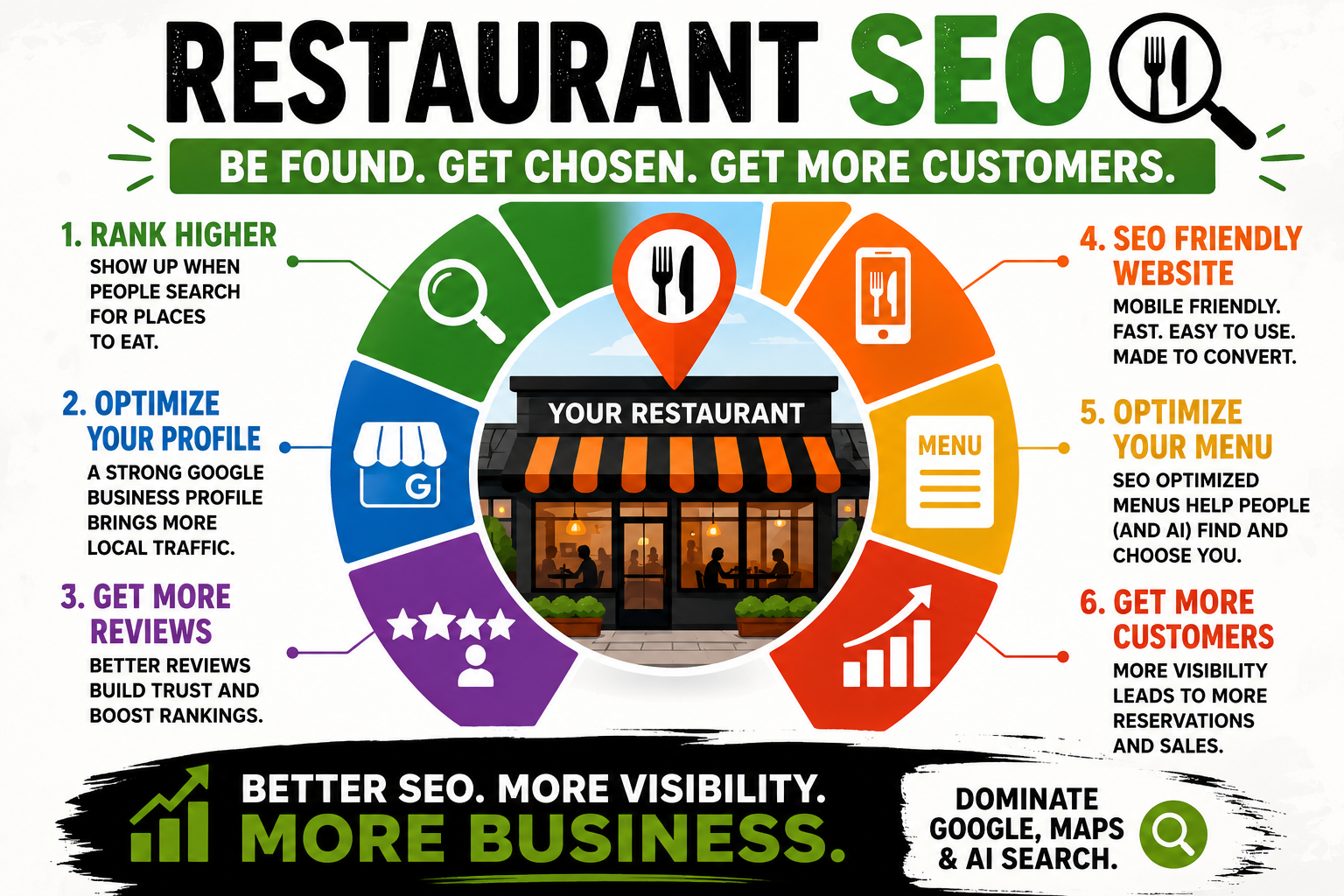
Corroboration. A restaurant described the same way by its own site, its Google profile, several directories and a local guide presents a coherent picture. One described differently in each place presents ambiguity, and ambiguity suppresses inclusion.
Quotable specifics. A model building a recommendation needs something to say about each option. A readable menu, a stated price range, a described atmosphere and dietary information supply raw material. A hero image and a phone number supply none.
Constraint matching. Real queries carry conditions — quiet, cheap, open late, good for groups, gluten free. Matching requires those attributes to exist as text somewhere readable.
Freshness. Recent reviews, current hours and updated menus suggest an operating business. Recommending a closed restaurant is a visible failure, so models weight against staleness.
Should a restaurant let AI crawlers read its website?
Yes. Blocking GPTBot, ClaudeBot, PerplexityBot and Google-Extended removes any possibility of being named in an AI recommendation. The reasoning that leads publishers to block these crawlers does not apply to you: a news site loses revenue when its article is summarized, but a restaurant sells tables, not text. Being quoted accurately with your name attached sends people to your door. Check your robots.txt — some website builders block these by default without telling you.
The honest position on AI optimization is that the underlying work — accurate structured data, listings that agree with each other, attributes stated plainly, real corroboration — is the same work that has improved local search visibility for a decade. That is reassuring, not disappointing. It means the effort is not speculative.
The agentic shift: when the assistant books the table itself
For about a year, AI agents could find your restaurant but not finish anything. As of two days ago, that gap closed. This is the part of the page that will age fastest, and the part worth understanding earliest.
Through most of 2025 and early 2026, the standard demonstration of an “AI agent booking dinner” ended the same embarrassing way: the model found the restaurant, displayed the available times, and then politely gave up and handed control back to the human.
On 10 August 2026, OpenAI turned on restaurant reservations inside ChatGPT through OpenTable, Resy and Yelp. A diner can now describe what they want in ordinary language — neighborhood, time, party size, cuisine, budget, dietary needs, atmosphere — see real available times in the response, and book one without leaving the conversation. Reservations are available globally through OpenTable and across the US and Canada through Resy and Yelp.
Google reached the same place from the other direction earlier in the year, adding AI-driven booking that handles finding a restaurant, checking availability and confirming the reservation as one flow. Gemini books through Reserve with Google, and Microsoft Copilot has its own OpenTable integration.
What does agentic booking change for a restaurant?
It compresses discovery and commitment into a single step. Previously a diner who asked an assistant for recommendations still had to visit a website or a map to act, which gave your site a second chance to convince them. Now the decision can complete inside the conversation. That raises the value of being named in the recommendation itself, and it raises the value of having live availability exposed through a reservation platform the assistants can actually reach.
What this means practically, today
- Being bookable is now a visibility factor. If you take reservations but only by phone, an assistant can recommend you and still not close the loop. Restaurants on a supported reservation platform get the whole path.
- Waitlists count too. Yelp's integration includes joining a waitlist, which matters for walk-in-heavy rooms that never took bookings.
- Your attributes are now the filter. When someone asks for “quiet, under $40, vegetarian options, 7pm, party of four,” every one of those is matched against documented facts. Undocumented facts do not exist.
- Nothing here is purchasable. There is still no ad slot inside an AI recommendation. Inclusion is earned through documentation, which is unusually fair to independents.
Where this is heading
Reservations were chosen as the first agentic use case deliberately — they are high volume, high intent, and low stakes, because the worst outcome is an empty table rather than a disputed charge. Payment is the harder problem, and the rails for it are being built now through efforts like the Agentic Commerce Protocol.
The reasonable expectation is that ordering follows booking. When an assistant can place a takeout order the way it can now hold a table, the restaurants that already publish structured, machine-readable menus will be the ones it can order from. The restaurants whose menus are photographs will be skipped, silently, by a system nobody can appeal to.
Which brings the whole page back to the same unglamorous point: publish your facts in a form a machine can read.
Technology that earns its keep, and technology that does not
Restaurants get sold a great deal of software. Most of it is a distraction from margin. A short, opinionated read on what is actually worth the monthly fee for an independent operator.
Direct online ordering
The clearest margin decision available to most restaurants. Marketplace commission runs 15–30% per order, with effective cost often reaching 30–40% once promotions, processing and refunds are counted. Pickup commission is typically far lower than delivery, so pushing pickup to your own channel is the fastest version of this fix.
There is also a correction worth knowing: marking your delivery prices up by the commission rate does not break even, because the commission is charged on the marked-up price too. At 30% commission the required markup is 42.9%, not 30%.
Tap-to-open menus at the table
NFC tags and QR codes both simply open a web address. The value is operational rather than magical: you change a price or 86 an item once and every table sees it immediately, with no reprinting. Guests with dietary needs can filter without interrogating a server.
The condition is that the destination must be a real page. Point it at a PDF and you have added a tag to an invisible menu. Point it at a proper page and the same asset serves both the room and the search engines.
A phone that always gets answered
Unglamorous and consistently underrated. Missed calls during a rush are lost covers, lost catering, and lost reservations. Voice assistants that handle bookings and common questions now run in the low hundreds per month for a single location, and the payback is straightforward: it is measured in saved calls, not in vibes.
Survey data suggests guests are largely comfortable with it — the resistance is usually on the operator's side, not the diner's.
Loyalty apps nobody downloads
A branded app has a real cost and an install-rate problem. Retention is genuinely valuable — a modest lift in repeat visits moves profit meaningfully — but a phone number at the till or an email list often captures most of the benefit at a fraction of the cost and friction.
Anything sold as an SEO guarantee
Nobody controls Google's ranking, and nobody controls which restaurants an AI assistant names. A vendor promising position one by a date, or guaranteed inclusion in ChatGPT, is describing something they cannot deliver. Ask what the actual deliverables are instead.
Tools that do not talk to each other
Five subscriptions holding five different versions of your menu is how prices end up inconsistent across the internet — which is precisely the inconsistency that suppresses AI inclusion. Fewer systems that agree beats more systems that do not.
Is NFC or QR better for a restaurant menu?
They solve slightly different problems. QR is universal, free to produce, and works on any camera. NFC feels better in a well-designed room, requires no camera app, and survives dim lighting where a code is hard to scan. Neither has any effect on search visibility on its own. If your room is dark or upscale, NFC is the nicer guest experience; if you want the cheapest thing that works everywhere, QR is fine. Both are only as useful as the page they open.
What it costs, how long it takes, and what nobody can promise
This section exists because the alternative is a quote request form, and you deserve to know roughly what you are walking into before you talk to anyone — including us.
Doing it yourself
Genuinely possible, and for a single-location restaurant with a capable person on staff, genuinely sensible. The direct cost is close to zero: a Google Business Profile is free, Apple Business Connect is free, and asking for reviews costs nothing.
The real cost is hours. Roughly a full day to claim and complete your listings properly, another day or two to convert a menu into a decent web page, and then two to four hours a month, indefinitely — replying to reviews, refreshing photos, updating hours, posting, and keeping the menu current. It is the indefinite part that defeats most operators, not the setup.
Hiring it out
Ongoing local SEO for a single-location independent restaurant typically runs somewhere in the several-hundred to low-four-figures per month range depending on scope and market. A one-time cleanup — listings, menu conversion, structured data, technical fixes — is usually a project fee rather than a retainer. A website build varies enormously with what it does; a fast informational site is a fraction of a custom ordering application.
We are not going to print a price grid here because a quote without seeing the restaurant is a guess dressed as a number. But that is the shape of it, and if anyone quotes you something wildly outside it in either direction, ask why.
Timeline, honestly
- Days: listing claims and corrections, hours fixes, phone number fixes. Some of these show up almost immediately.
- Two to six weeks: menu conversion and structured data begin to be crawled and reflected.
- Two to four months: review velocity changes start moving the rating and the recency signal.
- Three to six months: meaningful movement in map pack placement for competitive terms, assuming the fundamentals were the problem.
- Ongoing and unpredictable: AI inclusion. It improves as corroboration builds, but no one can put a date on it.
What no honest provider will promise you
- A specific ranking position by a specific date
- Guaranteed inclusion in ChatGPT or Google's AI answers
- A fixed number of new covers per month
- Removal of a legitimate negative review
- Results that survive a bad product — visibility accelerates whatever your restaurant already is, in both directions
Is SEO or paid advertising better for a restaurant?
They do different jobs and the honest answer is usually both, in sequence. Paid advertising buys immediate visibility and stops the moment you stop paying — useful for an opening, a slow season, or a new daypart. Organic visibility takes months to build and continues working afterward, and it is the only one that affects whether an AI assistant names you, since there is no ad slot there. If you have to choose one and you are not in a hurry, fix the organic foundation first, because paid traffic sent to a restaurant with a two-star rating and a PDF menu converts badly and wastes the spend.
The mistakes we find most often
Drawn from audits of independent restaurants. None of these are exotic. Nearly all of them are free to fix, and several are being made right now by a restaurant that is otherwise doing everything well.
Nobody at the restaurant can log into the Google profile
Set up years ago by a web designer, a former manager, or a marketing company that has since gone quiet. The listing is live, wrong in some small way, and unfixable. Reclaiming ownership takes days to weeks, so start before you need to.
Holiday hours never set
The most expensive small mistake in the category. Google shows you as open, someone drives across town on Thanksgiving, and you receive a one-star review for a decision you made months earlier. Set special hours for the whole year in one sitting.
The menu is a photograph
Covered at length above, and still the single most common finding. Often the menu is beautiful, professionally designed, and completely unreadable to every system that decides who gets recommended.
Different details in different places
Suite number on the website, missing from Yelp. Old phone number on a directory nobody remembers submitting to. “Restaurant & Bar” in one place, “Restaurant and Bar” in another. Each inconsistency lowers machine confidence, and machine confidence is what determines whether you get named.
Reviews answered in batches, months apart
Twenty replies posted on the same afternoon reads exactly as it is. Meanwhile 19% of diners now expect a same-day response. Ten minutes at open and ten at close beats a quarterly session.
A delivery marketplace outranking you for your own name
Someone searches your restaurant by name and the first result takes them to a third-party page where you pay commission on the order. You lose the margin and the customer relationship on a search you should own outright.
Keyword stuffing the business name
“Tony's Pizza — Best Italian Restaurant Denver Delivery” was a grey-hat trick that mostly worked for years. Google's 2026 enforcement wave has been suspending profiles for it. If your listing name is not the name on your door, change it.
Photos from the soft opening
Empty dining room, different chairs, a menu you stopped serving in 2022. Photos are sorted by recency now, and stale imagery reads as a business coasting. A phone camera and fifteen minutes on a busy night fixes it.
Nothing on the website says what you are
Sites that open with a full-screen image and the word “Welcome” and never plainly state the cuisine, the neighborhood, or the price range. A machine reading that page learns almost nothing it can use to recommend you.
Blocking the crawlers by accident
Some website builders block AI crawlers by default, and some sites are still carrying a noindex tag left over from development. Both are silent and both are total. Worth checking once a year.
The 60-second restaurant visibility checkup
Six questions, answered honestly, against the thresholds in the 2026 consumer data. Runs entirely in your browser — nothing is sent anywhere, nothing is stored, and there is no email box to fill in.
Where does your restaurant actually stand?
Tap an answer for each. Your results appear below.
1. What is your Google star rating right now?
2. Roughly how many Google reviews do you have?
3. How old is your newest review?
4. How is your menu published on your website?
5. Do you reply to reviews?
6. Which of these have you actually claimed?
Detailed guides on each piece
This page is the overview. Each of these takes one part of it apart properly, with the specifics, the edge cases and the things that go wrong.
Restaurant menu SEO
Converting a PDF or photographed menu into pages that search engines and AI models can read, including menu structured data, dish-level pages, dietary markers, and how to update prices without losing what you built.
Read the menu guide → Guide 02Google Maps & local visibility
How the local pack actually decides, what proximity, relevance and prominence mean in practice, profile completion in detail, the 2026 changes to Q&A and freshness, and the most common reasons a restaurant is missing from Maps.
Read the Maps guide → Guide 03Reviews, ratings & response
Thresholds, velocity math, how to ask without breaking platform rules or FTC guidance, how to write replies that work on the audience rather than the reviewer, and what to do about a review you believe is fake.
Read the reviews guide → Guide 04AI search visibility (AIO & GEO)
Getting named by ChatGPT, Gemini and Google AI Mode: entity consistency, corroboration across independent sources, machine-readable attributes, crawler access, and how to test whether assistants currently know you exist.
Read the AI guide →Where to go from here
Tools, directories and services that act on what is described above — built and maintained by the same team.
Restaurant SEO questions, answered directly
What is restaurant SEO in simple terms?
It is the work of making sure your restaurant appears — accurately and appealingly — when someone nearby searches for a place to eat. That means claiming your listings on Google, Apple Maps and review platforms, publishing your menu as readable text rather than a picture, earning steady recent reviews, keeping your name, address, phone and hours identical everywhere, and running a website that loads fast on a phone. It is not a trick played on an algorithm; it is publishing accurate facts where machines and diners can both read them.
How do I get my restaurant to show up on Google?
Claim a free Google Business Profile at google.com/business using an email address your restaurant controls. Verify by phone, text, WhatsApp or video. Then complete every field — precise category, hours including holidays, phone, website, attributes, and a menu link pointing at a real page. Add current photos and keep adding them. Verification usually clears within a few days, and listing corrections often appear within a week. If you are already listed but not appearing, the usual culprits are an unverified profile, a suspension, duplicate listings, or a wrong map pin.
Why isn't my restaurant showing up on Google Maps?
Most often the profile was never verified, or it has been suspended — frequently for a keyword-stuffed business name or an address that does not match. Other common causes are duplicate listings competing with each other, a map pin dropped in the wrong place, a primary category that is too generic, or a business name that does not match your signage. It can also simply be distance: if the person searching was outside your area, no optimization changes that. The first four causes are all fixable, and all four are more common than owners expect.
Can Google read a PDF menu?
Poorly, and often not at all. Google can sometimes extract raw text from a PDF but cannot reliably interpret its structure — which line is a dish, which number is a price, which heading is a section. A photographed or fully designed menu is worse, because the words are pixels rather than text. AI assistants hit exactly the same wall, which makes dish-level recommendations impossible for restaurants whose menus exist only as documents or images. Publishing the menu as text on a web page is the single highest-impact change most restaurants can make.
How many Google reviews does a restaurant need?
At least twenty, with fifty or more as a working target. 47% of consumers will not use a business with fewer than twenty reviews, and only 9% will use one with five or fewer. Recency matters as much as volume: 74% only weigh reviews from the last three months, so roughly four new reviews a month is the minimum rate to keep your newest review inside that window all year. The constraint is usually asking, not willingness — 83% of people who were asked for a review wrote one.
What star rating does a restaurant need in 2026?
4.0 is the functional minimum and 4.5 is the target. 68% of consumers require at least four stars, up from 55% a year earlier, and 31% will only use a business rated 4.5 or higher, up from 17%. Only about 10% insist on a perfect five, so a 4.6 or 4.7 sits comfortably in the range that satisfies nearly everyone. The important detail is how fast that moved: a rating that was comfortably acceptable in 2025 may now be below the cutoff for nearly a third of searchers.
How does ChatGPT decide which restaurants to recommend?
No AI company publishes its selection logic, so this is observation rather than confirmed mechanics. What consistently appears to matter is corroboration — consistent, verifiable information about your restaurant across several independent sources — along with specific quotable attributes such as dishes, prices, atmosphere and dietary options, and signals that the information is current. What does not appear to matter is paid advertising, since there is no ad slot inside an AI recommendation, along with social follower counts and third-party authority scores. Being invisible usually traces back to thin documentation rather than a penalty.
Can ChatGPT book a table at my restaurant?
As of 10 August 2026, yes — if you are on a supported reservation platform. OpenAI turned on in-chat reservations through OpenTable, Resy and Yelp, letting a diner describe what they want, see real available times, and book without leaving the conversation. Reservations are available globally through OpenTable and across the US and Canada through Resy and Yelp; Yelp's integration also covers joining a waitlist. Google and Microsoft Copilot have comparable booking paths. If you only take reservations by phone, an assistant can still recommend you but cannot complete the booking.
Do NFC menus or QR codes improve SEO?
No, not by themselves. Both are simply methods of opening a web address at the table. What determines whether a menu is searchable is the destination: a real HTML page with text and structured data is readable, while a PDF or image is not. An NFC tag pointing at a PDF is exactly as invisible as a QR code pointing at the same PDF. Choose between them on guest experience — NFC feels better in dim or upscale rooms, QR works on any camera for free — and make the SEO decision about the page they open.
How long does restaurant SEO take to work?
Listing corrections such as hours and phone numbers can appear within days. Menu conversion and structured data typically begin to be reflected within two to six weeks. Review velocity changes start moving your rating and recency signals over two to four months. Meaningful movement in competitive map results usually takes three to six months, assuming the fundamentals were what was holding you back. AI inclusion improves as corroboration builds but cannot be scheduled. Anyone offering a specific position by a specific date is describing something they do not control.
Is SEO or paid advertising better for a restaurant?
They do different jobs. Paid advertising buys immediate visibility and stops when the budget stops, which suits an opening, a slow season or a new daypart. Organic visibility takes months to build and keeps working afterward, and it is the only one that influences whether an AI assistant names you, because there is no ad inventory inside an AI recommendation. If you have to pick one and you are not in a hurry, fix the organic foundation first — paid traffic pointed at a restaurant with a weak rating and an unreadable menu converts poorly and wastes the spend.
Should I block AI crawlers from my restaurant website?
No. Blocking GPTBot, ClaudeBot, PerplexityBot or Google-Extended removes any possibility of being named in an AI recommendation. The logic that leads news publishers to block these crawlers does not transfer: a publisher loses revenue when its article is summarized, whereas a restaurant sells tables. Being quoted accurately with your name attached sends people to your door. Worth checking your robots.txt directly, because some website builders block these crawlers by default without making it obvious.
Do I need a website if I have a Google Business Profile?
Yes, and the gap is widening. 54% of consumers now visit a business website after reading positive reviews, up from 32% in 2019, while only around 40% of local businesses have one. The profile controls how you appear in search and Maps, but the website is where the menu lives, where AI systems verify your details, and where the decision usually closes. It does not need to be elaborate — menu, hours, location, phone, loading in about a second on a phone covers the great majority of what people want.
What is the single highest-impact change for restaurant visibility?
For most restaurants, converting the menu from a PDF or image into readable text with structured data. It turns every dish into a phrase you can be found for, unlocks the highest-intent searches in the category, and gives AI assistants specific facts to quote about you. Second is claiming and completing the Google Business Profile, which a surprising share of small businesses still have not done — only about 35% have one at all. Both are cheap relative to almost anything else a restaurant spends money on.
Can I do restaurant SEO myself?
Much of it, yes. Claiming listings, setting holiday hours, asking for reviews and replying to them, and keeping photos current are all free and require no technical skill — just time and consistency. The parts that usually need help are converting a menu into properly structured pages, fixing site speed, cleaning up conflicting listings across dozens of directories, and diagnosing why something is not appearing. Expect roughly a day or two of setup and then two to four hours a month indefinitely. It is the indefinitely that defeats most operators, not the difficulty.
Who publishes this, and why it is free
RestaurantsSEO.com is published by Eye To Ad Media, a search agency working on local and restaurant visibility from Denver, Colorado. It is written and maintained by Zachary Tye Wennstedt.
We built this because the same conversation kept happening on sales calls. An operator would repeat something they had heard at a conference — a statistic, a rule about Google, a claim about what NFC does — and when we went looking for the source, there frequently was not one. Publishing the accurate version costs us nothing and saves everyone the argument. It also means that when we do tell a restaurant its menu is unreadable or its rating has fallen below the threshold, we are pointing at something checkable rather than asking to be trusted.
If you take this page and fix your own restaurant without ever contacting us, that is a genuinely fine outcome and it is why none of it is behind a form. If you would rather have it done, that is the business, and the number is at the top of the page.
How we source
- Every statistic names its study and year. Figures we could not trace to an original source were left out.
- Where something is inference rather than confirmed mechanics — particularly around AI selection — we say so in the text.
- Product and platform behavior is dated, because it changes. This page states when it was last updated.
- No invented case studies, no fabricated client results, no guarantees about rankings.
Want someone to look at yours?
We will check all nine surfaces, tell you what is broken, and give you the findings regardless of whether you hire us. If the answer is that you are in good shape, we will tell you that too — it happens more often than you would think.
Request a visibility auditThe short version, one more time
Claim your listings and keep them accurate. Publish your menu as text. Ask for reviews and answer all of them. Make your site fast. Say plainly what you are, where you are, and what you serve. Do that and you will be on more roads than most of your competition — on Google, on Maps, and inside the AI answers that are increasingly deciding where people eat.